When her father first showed four-year-old Gulmira Dauletova how to move chess
pieces, he could hardly have imagined that he was laying the foundation for a path
that would lead her to the top of the world chess community. Today, Gulmira is an
international women’s grandmaster, executive director of the Kazakhstan Chess
Federation, and chair of the women’s commission.
Huddle shares an exclusive interview with Gulmira Dauletova, a woman who
changed the country’s chess landscape both on and off the board.
Gulmira was introduced to chess thanks to her father, a Master of Sports of the
Soviet Union. Every evening after work, they would play a game – without a queen
and a rook, as is proper to begin learning.
“My dad taught me chess. He is a candidate for master of sports. Despite the fact
that he worked from morning until night in the 90s, he found time to play a game with
me every evening. First I removed the queen and the rook to make it easier for me,
and then we played at full strength,” she recalls.
The road to international recognition was not easy: “I remember a bright moment in
Iran. I had a winning position, but I did not see the tactics – I lost to a girl with a low
rating and burst into tears. I told the coach: “That’s it, I’m quitting chess!” But he
answered me: “Go, come back tomorrow.” I came back. Such thoughts never came
to mind again.”
She received the title of international women’s grandmaster in parts: “The first point –
in the Czech Republic in 2007, the second – at the World Team Championship in
China in 2015, the third – in Serbia, in 2020. It was a long road. 13 years.” She
graduated from school with Altyn Belgi, entered the South Kazakhstan State
University, then the KAZNU Master’s program, and completed internships in Cyprus
and Spain.
“I never put chess above studying,” Gulmira emphasizes. “My parents are teachers.
Since childhood, they told me that education is the most important thing. I even went
to tournaments with textbooks. I always had two parallel lines – sports and education.
I graduated with honors.”
In 2015, after completing her master’s degree, Gulmira began working at the
Kazakhstan Chess Federation. “At first, I helped with translations and organizing
tournaments. Then I was invited to work – first as a coordinator, and after a month or
two, I became deputy director. And in 2022, I became executive director.”
One of her key achievements was obtaining official accreditation for the Federation
from the Ministry of Sports. Under her leadership, Kazakhstan made a breakthrough:
in 2023, the country’s young chess players won 123 medals, and in 2024, 160.
Kazakhstan began to overtake such countries as China, India, and Russia in team
standings. Dauletova began to oversee national programs to support young chess
players. “In 2023, our children won 123 medals at international tournaments. In
2024, 160. We hold amateur tournaments among diplomats, teachers, military
personnel, and even prisoners.”
In 2023, chess was introduced as an elective in 42 schools. In 2024, it was
introduced in 550. “We don’t want to make a champion out of everyone,” she says,
“we use chess as a tool for developing structured thinking.”
The Federation has also created a support system for young talents: training,
tournaments, scholarships, laptops, gyms, books — everything is provided free of
charge. “A child from the “golden package” receives the equivalent of 25 million
tenge — these are services, not cash. He should only study and play.”
Dauletova is an active participant in the Women’s Commission of the
International Chess Federation and the initiator of gender equality in
Kazakhstani chess: “We have achieved that the prize funds for men and women are the same. In
other countries, this is still rare.”
She conducts master classes for girls all over the world, including in Asian
countries, where women’s chess is still perceived as something secondary.
One of the significant achievements in the international work of the Kazakhstan
Chess Federation under the leadership of Gulmira Dauletova was the signing
of a memorandum of cooperation with the Chess Federation of the United Arab
Emirates.
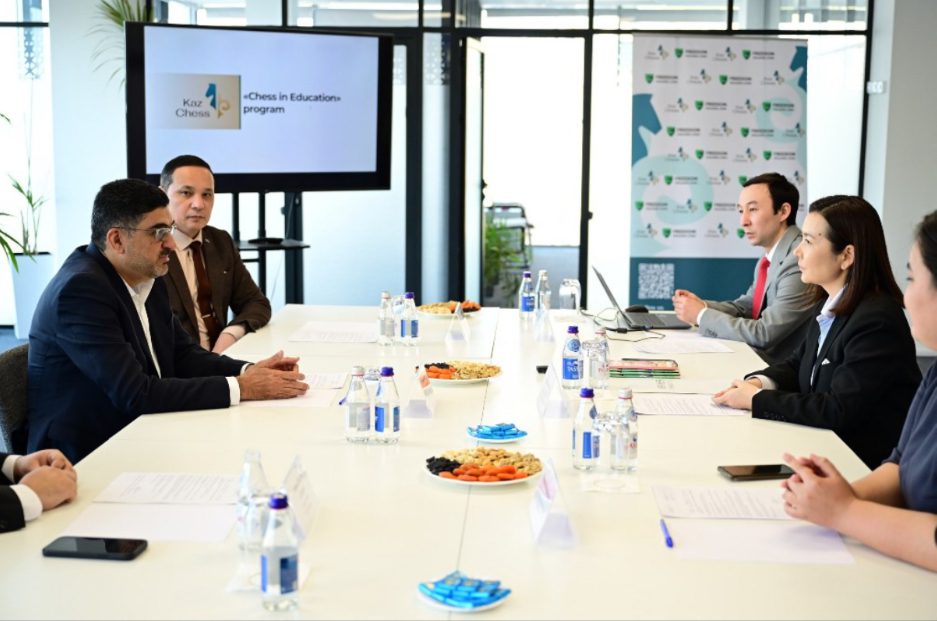
“The Secretary General of the UAE Federation wrote to us in advance that he
wanted to come and personally study how chess education is organized here.
When he saw our schools, manuals, equipment, coaching system, he was
delighted,” says Dauletova.
Unlike Kazakhstan, where the chess movement is coordinated at the national
level, the Emirates has a club system, where each club works according to its
own program. The Kazakh model, based on the strategic document for the
development of chess until 2027, made a strong impression on our Arab
colleagues.
“We translated our strategic plan into English and handed it over to our
partners. It covers seven key areas – from professional chess and mass
coverage to infrastructure and personnel training,” explains Gulmira.
“We gave them our manuals – a textbook and a manual. Now they are adapting
them to their system,” notes Dauletova. The parties also discussed the
possibility of organizing joint tournaments and cultural exchanges between
schoolchildren and young chess players of both countries.
“There is interest in chess in the Emirates, but there is still a lack of systemic
approach. We are ready to share our experience. This is real chess
diplomacy,” she emphasizes.
One of the main areas of the near future is the expansion of chess education:
“Already now, in 2025, there are another 300 applications in schools for chess. This
is evidenced by the growing interest of society, especially parents, who note: “Those
children who play chess are more diligent, they have more concentration.”
One of the key future projects is complete digitalization: “We are now planning to
completely digitize the chess world so that each chess player has their own ID, so
that they can register with us on the website and we will maintain a complete
database of all our chess players.” Personal accounts will display ratings,
achievements, coaches and even growth dynamics, as well as a visual profile of
each player.
A system for certification of chess schools is also being developed: “We will also
register each chess school on the website, give them licenses, certification.”
The Federation is betting on systematic, long-term work: “When you water the plants
all the time, take care of them, they start to show fruit. So that every child has equal
opportunities, so that chess can enter every door, every corner. This is our second
big goal.”
Autor: Sabina Naukebayeva