What the forum revealed about the scale of Kazakhstan’s technological transformation and its place on the global AI agenda
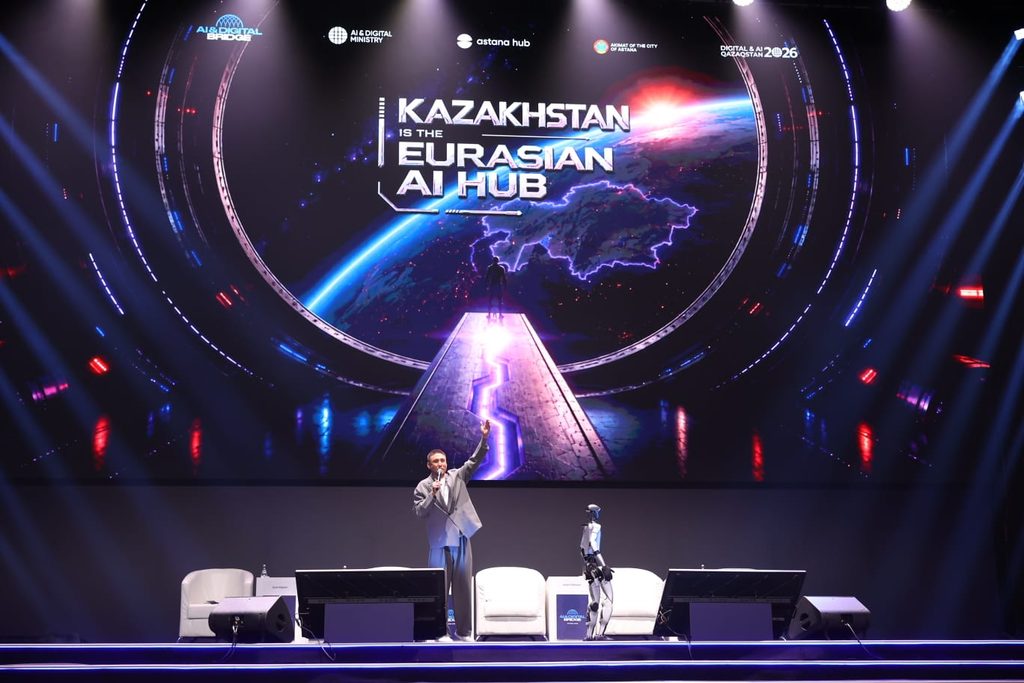
Beyond being a major technology forum, AI & Digital Bridge 2026 served as a platform where Kazakhstan brought together government strategy, international expertise, investment, infrastructure, startups, and human capital.
The forum took place on October 1–3 in Astana and served as the central international event of AI MONTH, organized as part of the Year of Digitalization and Artificial Intelligence. The central theme of the forum was positioning Kazakhstan as the Eurasian AI Hub.
The scale of the event is underscored by the numbers: the two-day open program recorded over 47,000 visits and more than 18,000 unique visitors. The business program featured 429 speakers, including 114 international experts, and comprised 106 panel sessions. The exhibition showcased 96 startups, 49 IT companies, and 42 individual booths. During the forum, 61 memoranda and agreements were signed.
Yet the main result of the forum goes beyond the scale of its audience. AI & Digital Bridge demonstrated the model of technological development Kazakhstan is striving to build and how this model fits into the broader international context.
1. Kazakhstan is transitioning from digitalization to a full-fledged AI economy
At the forum, artificial intelligence was viewed not so much as a standalone technology, but as a new economic infrastructure.
Deputy Prime Minister and Minister of Artificial Intelligence and Digital Development Zhaslan Madiyev spoke about the five levels of the AI economy: energy infrastructure, chips, cloud platforms, language models, and applied solutions.
This is an important shift: a country’s competitiveness in AI is increasingly determined less by the number of individual digital projects and more by the presence of a complete technological ecosystem.
2. AI is becoming part of state economic policy
AI & Digital Bridge 2026 was opened by the President of Kazakhstan, Kassym-Jomart Tokayev. In his speech, he linked the development of artificial intelligence with industry, finance, education, science, and public administration, and called the forum a “golden bridge” for international contacts in the field of new technologies.
Thus, the AI agenda in Kazakhstan already extends beyond the IT sector and is viewed as part of a broader transformation of the economy and public administration.
3. Physical infrastructure is gaining importance on par with algorithms
One of the most noticeable trends of the forum was the focus on energy, computing power, and data centers.
The “Data Center Valley” project, with an energy potential of up to 1 GW, is in its active phase. Prime Minister Olzhas Bektenov called data centers the foundation for the development of AI, cloud services, science, and new digital industries.
This shows that the next stage of AI competition will take place not only at the model level, but also at the level of infrastructure, energy, and the ability to handle heavy computing workloads.
4. Kazakhstan is joining the global conversation on the architecture of the AI economy
The international program of the forum covered topics of the new economy, global technological competition, investment, human capital, robotics, and Physical AI.
Astana hosted Balaji Srinivasan, Kai-Fu Lee, Jamie Beaton, David Ripley, Ya-Qin Zhang, Rev Lebaredian, John Hopcroft, Omar Al-Olama, and other international technology leaders, investors, and researchers.
For the country, this is an important signal: Kazakhstan strives not only to import technologies, but also to participate in discussions on the rules, infrastructure, and economic models of the next stage of AI.
5. Venture capital is becoming more demanding
The “Capital for the AI Era” session discussed new investment strategies and Central Asia’s role in the changing geography of capital.
The general conclusion running through the investment and startup discussions at the forum was that a technological solution alone is no longer enough.
Investors increasingly look at the team, market access, market demand, proprietary data, and scalability.
In other words, the next stage for the Kazakhstan startup ecosystem entails an increase in the number of projects, as well as the emergence of more companies capable of growing beyond the local market.
6. Startups serve as one of the channels for international integration
The startup program of the forum demonstrated just how international Kazakhstan’s technological ecosystem is growing.
Astana Hub Battle received 292 applications from various countries. Following the selection process, 50 projects advanced to the semifinals, and 14 reached the final. The total prize pool amounted to $100,000, while the Aman startup additionally secured a $200,000 grant from MA7 Ventures.
This is no longer merely a competition of ideas. Such formats connect local teams with investors, corporations, and international partners, creating infrastructure for further scaling.
7. Kazakhstani technology products are increasingly expanding beyond the country
The results of the AI & Digital Bridge Awards demonstrated that a segment of Kazakhstan’s ecosystem is already operating globally.
The HealthTech startup Rette launched pilot projects in the United States and was selected for Mayo Clinic Platform Accelerate. GoPrep attracted over 31,000 students from 139 countries. According to data presented for the award, Higgsfield AI reached more than 30 million users across 238 countries and territories.
For Kazakhstan, this serves as an important indicator: the focus is now not only on domestic digitalization, but also on the development of export-oriented technology companies.
8. Talent is emerging as one of the primary resources of the AI economy
A dedicated block of the forum’s program focused on human capital. The session titled “Who Will Power the AI Economy?” addressed which competencies will define the labor market and how education must adapt to AI.
The core question here shifts from the quantity of IT specialists to the quality of new expertise: professionals capable of integrating AI with industry, healthcare, science, finance, and engineering are required.
For this reason, the opening of the first AI university, Qazaq AI Research University, formed an integral part of the forum’s strategic agenda.
9. AI is extending far beyond the IT sector
The program demonstrated that artificial intelligence is penetrating traditional and creative industries ever more deeply.
Dedicated sessions explored robotics and Physical AI, healthcare, industry, finance, public services, education, film, and music.
The Astana AI Film Festival received over 8,000 submissions from 125 countries, highlighting international interest in new AI-driven creative formats.
This is an important sign of the maturity of the agenda: AI is no longer merely the domain of technology companies, but is becoming a tool for transforming a wide range of industries.
10. From Dialogue to Practical Results
One of the most telling outcomes of AI & Digital Bridge 2026 was the signing of 61 memoranda and agreements spanning technology, investment, education, digital products, and international cooperation.
This is where the forum goes beyond the traditional conference model.
It brings together the state, international companies, startups, investors, universities, and potential clients, turning ideas into real projects.
According to Olzhas Bektenov, the next stage is to scale solutions that have already proven their effectiveness and introduce new technologies and digital standards into the economy.
This is the practical meaning of positioning Kazakhstan as the Eurasian AI Hub. Kazakhstan strives to become a point where infrastructure, capital, talent, scientific expertise, and global markets converge.
The main takeaway from the forum is that the next phase of AI will be determined not by the number of new models, but by countries’ ability to transform technologies into infrastructure, investment, export-oriented companies, and productivity. For Kazakhstan, this ability is the key step toward becoming a Eurasian AI hub.
AI & Digital Bridge 2026 took place in Astana from October 1 to 3 at the EXPO IEC venue.